
Will We Disappear in the Cover of the Sky?
Team Members: Aarti Bhalekar & Anushka Khemka
Sound Designer: Lian Dyogi
My research role in this project focused on exploring how urbanization affects bird behavior, with an emphasis on starlings. I studied how these birds adapt to changing environments and investigated their social patterns. This research was conducted through an analysis of scientific reports, conversations with experts who work with birds, and two key books: In Flight with Starlings by Giorgio Parisi and Ecology and Conservation of Birds in Urban Environments by Enrique Murgui.
Once our research was complete, our team divided the tasks, and I took on the role of storyboarding our film. I also served as the creative technologist, animating the farm and city scenes featured in the final production.
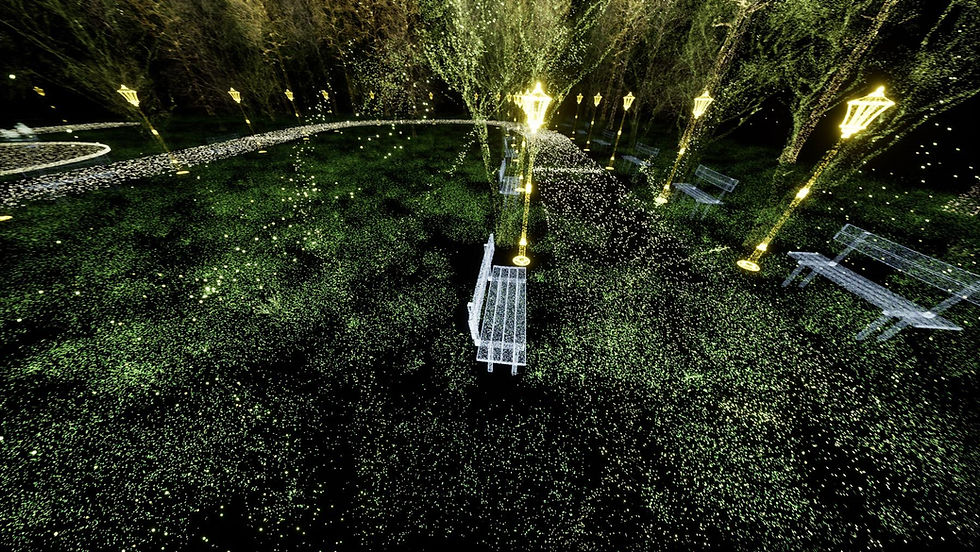
Will We Disappear in the Cover of the Sky? is an immersive experimental film that invites viewers to traverse a series of landscapes from an urban park to the higher altitudes of open skies. A more-than-human perspective emerges as a starling narrates, through subtitles, its account of the challenges brought about by rapidly expanding human activity.
According to RSPB’s Big Garden Birdwatch, the average count of starlings in the UK has decreased by 82% since 1979. Through this film, we hope to inspire reflection and action to protect these vital species.
For a more detailed look behind the scenes, covering our research and storytelling process you can read our article in It’s Freezing in LA!
The process video offers a behind-the-scenes look at how we approached our project, starting with research and development, progressing to scriptwriting and storyboarding, and ultimately executing it technically in Unreal Engine. It also highlights our collaboration with the sound designer to bring our film to life
The Research
To inform our project, we conducted extensive primary research through a combination of site visits, expert consultations, and literature review. We visited the Natural History Museum's Birds: Brilliant and Bizarre exhibition, which deepened our understanding of bird behaviour, evolution, and the growing threats they face, validating much of our earlier desk research. A key finding was that Starling populations have declined by 82%, as recorded through the RSPB's Big Garden Birdwatch citizen science initiative. To further our knowledge, we consulted six specialists across ornithology and conservation. Conversations with them gave us access to insights and research papers not readily available online.

The Narrartive
Our narrative focuses on two primary issues: First, how intensified cattle farming disrupts starling foraging patterns.
Second, how urban landscapes, particularly glass buildings, create barriers to wayfinding. Birds often cannot distinguish reflective surfaces from open sky, turning architecture into invisible hazards.
The storytelling is guided primarily by visuals, sound and on-screen text. We deliberately chose not to use a voiceover, as we wanted to avoid anthropomorphising the starling’s perspective. A human voice could unintentionally impose human characteristics onto a non-human subject, which would undermine the project’s intention to explore a more-than-human perspective.
The story begins with a starling waking up in a city park, where it has spent the night. As morning breaks, it prepares to leave and forage for food in nearby agricultural lands. Upon arrival, the murmuration splits into two; some begin searching for food, while others remain vigilant, scanning the surroundings for danger.
They manage to gather some food, but it isn’t enough to satisfy their hunger. The land is shared with other creatures, making resources scarce. As they journey back to the city, they face new challenges, struggling to distinguish glass from reality.
In the final moments, the starlings reflect on a nostalgic past and imagine a hopeful future, inviting the audience to consider what it means to share space with more-than-humans.

.jpeg)
The Visual Design
Here are a few stills from the film.
The inspiration of using particles came from the book "In Flight with Starlings," where the author studies atomic structure behaviour through the movements of the starling birds. The particles here dance like the electrons and protons that Parisi talks about. They emulate the dynamic movements in atomic structure studies.They also hint towards the flocking patterns and agile movements of starling themselves
The particles also help us create a burst of colors that are in a constant shift - this is our artistic representation of what tetrachromats might see. The shift in colors can evoke a sense of heightened sensory experience.
%20.jpeg)


The Sound Design
Sound and camera movement are closely linked in the film , both shifting vertically to mimic the motion of birds and reinforce a sense of spatial presence. In the park and the farm, bird calls are more distinct and foregrounded, while human sounds are pushed to the back. In contrast, the bird sounds are later drowned by the city rumble. Subtle, jittery sound textures hint at an altered temporal rhythm and the perceptual world of the starling.
We wanted to stay close to reality while speculating about that reality from the eyes of another critter. A live-action or documentary approach seemed too close to a human’s perspective. We wanted our audience to enter a different body and start to think like another. Using a 3D engine allowed us to have a certain kind of creative freedom while still applying real-world physics.
The film was publicly showcased at Outernet, within the Now Pop One space, where it ran alongside other works for four days. This screening offered an exciting opportunity to share our message with a broad audience and engage the public in our exploration of urbanization and wildlife.


